The post Teaching Transferable Skills Using Routines: Self-Direction appeared first on Fearless Teachers.
]]>As teachers begin to implement Vermont’s graduation proficiencies, I am getting a lot of questions about teaching transferable skills. I don’t actually think this is new for teachers but since we have never been explicit about addressing skills like self-direction, collaboration, communication or problem solving as a content, so to speak, we haven’t yet articulated what this looks like as something that is taught explicitly. One of the ways I think teachers already teach these skills is through routines. Many students struggle with self-direction, so I collected some of the ideas below that I have seen being implemented and “teach” self-direction.
Solo Cups
 One of the indicators for self-direction is to “demonstrate initiative and responsibility for learning”. The first step in figuring out how to teach these skills is to identify what they “look” or “sound” like in action. One way a student could demonstrate this indicator is to identify when they need help or have a question and ask for assistance. Several of our teachers are using colored cups to identify their need for help. Green cups mean the student is confident about what they are working on. Yellow cups represent that a student needs help but is able to continue to work. Red cups are a sign that a student has a specific question that they need answered before they can move on. The teaching piece happens when a routine like this is introduced and then the routine itself offers an opportunity for students to practice. Teachers can use moments when the routine is not being used appropriately to provide feedback in order to reinforce the direct instruction.
The environment
The next three strategies are related to the same indicator as above. An English teacher has set up his room so that students physically decide where they are at in the learning process and sit at a specific table related to that. In his class, it looks something like a table for “I need to read”, “I’m caught up with the reading but I am confused”, “I need help getting started” and “I’m caught up and I get it”. He moves around the room checking in with students as needed and having discussions with them about their learning and next steps. Students need to identify where they are in their learning and make appropriate choices. As he checks in with students, he identifies and processes issues with these choices providing moments for feedback and reinforcement of teaching.
Checking in
Using a check in/ check out routine that includes daily goal setting can helps students demonstrate (and practice) initiative and responsibility for learning. Students create a goal at the beginning of class and then reflect on where they are with that goal at the end of class. This reflection allows students to process what worked or didn’t work as well as develop a plan for the next class. This could be collected on paper, through a google form or through a platform like google classroom, Edmodo or Schoolology. Collecting it allows teachers to keep up with where students are and how they are progressing, again offering that opportunity to give feedback or provide further teaching.
Goal Setting
 I recently sat with a student as she developed a goal around time management to improve her self-direction. After a lot of probing questions, she described the obstacle as “when I arrive to my academic time (AT) block, I don’t always know what to work on so I don’t get started right away and I get distracted easily”. We developed a very specific step to address this issue. The student agreed that she would plan ahead what tasks she would be working on each day during this time and she would add it to her iPhone calendar. I helped her look at her grades and consider upcoming assignments. Then we created very specific tasks that she would be working on during this time. The tasks are specific enough that she doesn’t have to think about it all when she gets to class. One such task was “type personal narrative essay and hand it in on google classroom”. I checked in with this student after we made the goal to make sure she followed through. I will check in with her again to see if it worked in a week. This very time consuming process of setting goals is certainly another effective way to teach self-direction although not always practical.
Mindfulness
In order to teach students how to “persevere in challenging situations”, one teacher is setting up a space in the room where students can go to get “unstuck”. This space will have some activities that may increase mindfulness or creativity in order to get unstuck. She talked about having brain teaser puzzles, Rubik’s Cube and coloring activities. It might also be place where students can simply talk to someone else about where they are stuck and process verbally. Because this is a physical place in the room, she can keep an eye on anyone who isn’t getting unstuck and intervene. This routine teaches kids some strategies that they can use in any situation. It also allows students to increase their awareness of this natural, yet frustrating part of learning.
Changes
As students are being offered more curriculum options and choice, teachers are naturally creating routines that help scaffold the learning of these skills. I think it is important to recognize that teaching transferable skills is not “another thing” we have to do. It is something we naturally do anyway and now that we are creating different types of learning experiences for kids, we will continue to create new strategies for them to learn the skills that are necessary for this type of learning. What routines are you using that teach transferable skills?
The post Teaching Transferable Skills Using Routines: Self-Direction appeared first on Fearless Teachers.
]]>The post Empowered or Engaged? appeared first on Fearless Teachers.
]]> This year, I explored proficiency-based learning, grading practices (or no grading practices) project-based learning, complex instruction and looking at math through a lens of social justice. As I visited schools and talked with educators and students, I was looking through the lens of engagement. Each of these topics does work to engage students but a common thread that came up through my research into these topics was the issue of self-direction. This came up as an obstacle and also a crucial skill. All of these learning strategies require students to be independent thinkers and learners. Since this is not a skill that has been previously required of students in a traditional system, it poses a significant obstacle. Self-direction is also something teachers have not taught before. So, all of these ideas promote more engagement for students because they all require more autonomy to begin with. This is where empowerment comes in. In order to implement any of these ideas, we will have to empower students. Empowerment requires not only self-direction but trust as well making it the perfect word to describe next steps in moving toward the type of system that will prepare students to function in a global economy.
I agree with Couros and the quote helped me get much more specific about what we are working toward, but I do think that engagement can play a role. It might be the first step in empowering students. Or maybe they work in tandem? When I imagined a traditional setting with more student empowerment, that didn’t really work either. So, we have to change what and how we are teaching and we need to be empowering kids to take more ownership over their learning through these changes. And how does trust factor into this scenario of change and transformation?
The post Empowered or Engaged? appeared first on Fearless Teachers.
]]>The post Creating Self-Directed Learners appeared first on Fearless Teachers.
]]>Motivation
We know a lot about motivation. Just consider what motivates you to learn and what doesn’t. When we have an interest in something because it is relevant to us, we are self-directed in our learning about it. Given an initiative sent down from the district…maybe not so much. Having choice in what students learn about does a lot to create an environment where students are more likely to self-direct. This doesn’t mean students aren’t working toward academic learning goals. The new teacher role is to figure out how to connect student interest and autonomy with academic learning goals that may not be student driven. Even when you are interested in something, you still need structures and help along the way.
Routines & Structures
I know that I am more productive when I have a plan in place. Developing routines and structures that will help students get started and stay focused once they have an idea can help them be more independent while still providing support. Consider a routine for entering the classroom that will get students working on their own right away. Setting daily goals could be one way to get started.

Identifying a way for the teacher to check in with students is an important aspect of this self-directed environment. I have seen several teachers use a sign-up list one the board to track students who needed to check in. One math teacher had several different sign up lists: students ready for a test, those who needed new instruction or those needing help with an existing topic. Another teacher just used a general check in list and moved through the list in order. Journaling, blogging, and exit tickets are easy routines for ending class and holding students accountable for the day’s work. Another method that I have seen is providing students with a form to complete or having them put completed work in a folder which you can then check. Moving work from one side of a portfolio to another can be a physical way to manage work coming in and the return of feedback. Creating a routine that ensures every student gets regular check-in time will prevent them from getting behind or overwhelmed for too long.
Outlines & Forms
Using outlines and forms to scaffold learning is nothing new. Every student is familiar with using an  outline to organize writing. Worksheets where students respond to prompts are second nature for our kids and they are very comfortable with this method. Graphic organizers might be of some use as well. This strategy can be used to scaffold a more complex task or to manage a longer, more open ended project. Google also offers a plethora of collaborative tools that most people are already using. Google forms are another way to check in and keep a record of where students are at on a daily basis. The biggest difference for us is going to be that we have to trust that they will do it if we expect them to do it and we will support them when they fail. We have to get okay with this otherwise they will never have the opportunity to gain the skills to begin with. What tools are you already using that could be tweaked to support more self-directed learning opportunities?
The post Creating Self-Directed Learners appeared first on Fearless Teachers.
]]>The post 7 Ways to Scaffold Self-Directed Learning appeared first on Fearless Teachers.
]]>If I said that students should be in charge of their own learning, I wonder how many would tell me that, while that was a nice thought, students wouldn’t be able to handle it? I know I certainly considered that myself. As we planned our first self-directed learning unit last month, I kept responding to this sense of fear. It’s the fear that students won’t be productive if they are working on independent projects. Since I was so fearful during this planning process, my co-teacher and I ended up planning for all the contingencies. And it worked! Learners need scaffolding for more self-directed learning to happen but with those scaffolds in place, they can be independent learners.
Focus on Getting to Know the Learner
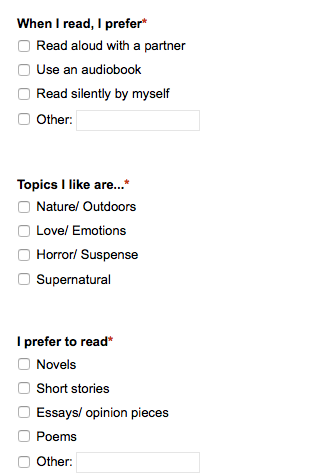 The very first activity we asked students to engage in was a learner profile. It asked questions about their level of self-directedness, what types of text they liked and didn’t like and their strengths and weaknesses in reading, writing, speaking and listening. This not only gave us information but it helped them hone in on their interests as well as their strengths and weaknesses before they made any choices about what they were going to study.
Give Students Choice About What & How They Can Learn
As Daniel Pink argues, autonomy is one of the major factors driving motivation. Having some choice and control over what and how we learn can have a major impact on our level of productivity and it is no different for a student learner. In our unit we gave students choice about what they would be reading from a list of authors, novels, poems, short stories and essays. They also had some choice about the formats of their study materials. Some watched videos or powerpoints on their authors. Many listened to an audio version of the text they were reading. Others chose to read a novel and headed to the library for silent reading time.
Create an Environment for Self-Directed Learning
We set up the room for different types of work areas. One table was for students who were mostly reading, another for researchers. There is a table for students who need help immediately and a table for students who are able to work but want to check in with a teacher at some point during class. This structure has several benefits. For management purposes, it allows us to know where students are at in the learning process. For students, it forces them to consider where they are in the learning process and as a result, keeps them focused on a learning task and goal. More passive students are forced to make choices about where they are at instead of waiting for a teacher to help them.
Provide a Planning Tool
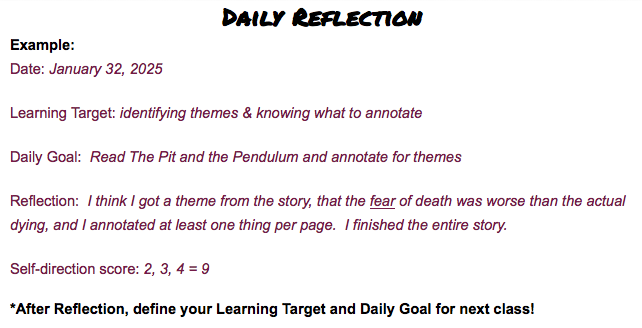
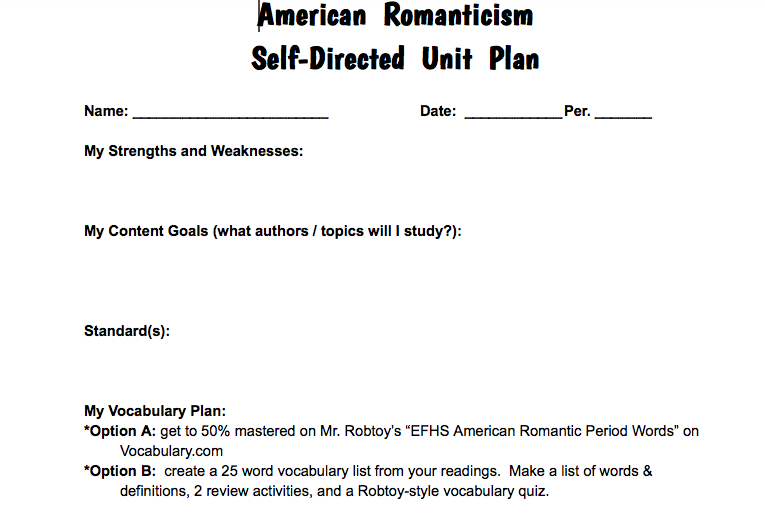 The planning sheet we provided required students to create a “big picture” plan with our help. Every day before students leave class, they set a daily goal for the next day. They also reflect on their progress toward that goal at the end of every class. We created this plan as a google doc and had each student make a copy, rename it and then share it with us.
Provide Standard Operating Procedures
We developed several standard operating procedures for students to follow during class. These include some standard student responses to obstacles like “I finished my goal for the day”, “I’m having technology problems” or “I need help and the teacher is not available”. These standard operating procedures should be geared to your particular situation and represent the routines and procedures you would normally have in your class but now need to shift because of a more self-directed environment.
Monitor Productivity Behaviors
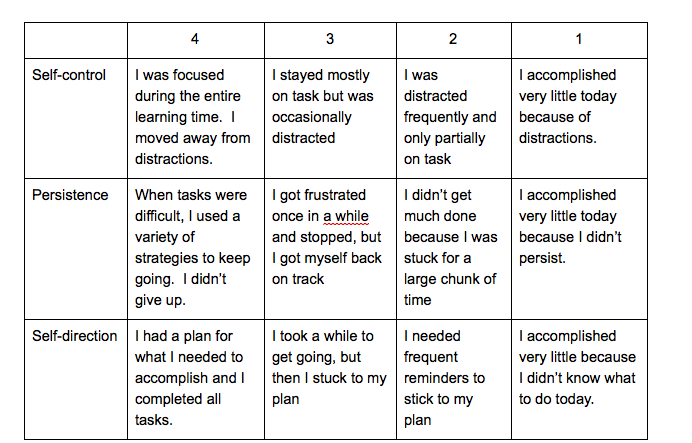 We are monitoring productivity behaviors such as “working while waiting”, “asking for help”, and “collaborating”. We are also keeping track of some of the negative behaviors that impact productivity in a classroom setting like socializing, “off-task with technology”, and “extended bathroom breaks”. My co-teacher and I keep track of these behaviors using classdojo. Other high tech options include Edmettle and RedcritterTeacher. Classdojo is the simplest solution but it only solves this one problem. Edmettle offers some interactivity so students and other teachers can also be tracking behaviors. RedcritterTeacher is the most complex but also offers many options for tracking not only behaviors but academic skills connected to the common core standards. In addition to our behavior tracking, students are reflecting on their self-directedness every day using a rubric which is laid out on their tables. They are keeping track of this in the shared google doc that houses their plan.
Identify Learning Targets in Kid Friendly Language
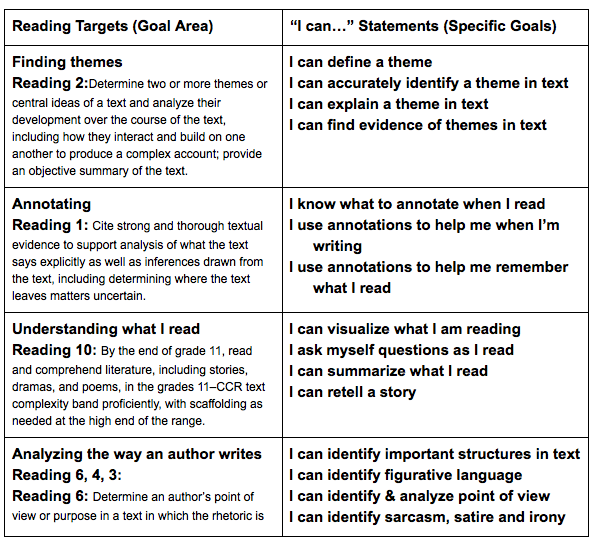 Also included in their google doc is a list of all the possible learning targets that they can work toward in this unit. They use these to focus their daily work. If they are going to read poems by Walt Whitman for example, they must choose a learning target for this activity to focus their work.
If you are working on more self-directed learning or personalized learning structures in your classroom or school-wide, please share them by making a comment, so that we can all benefit from the concrete ideas that are already working. Also, check out my more recent post on self-directed learning.
The post 7 Ways to Scaffold Self-Directed Learning appeared first on Fearless Teachers.
]]>