The post Social Emotional Aspects of Math appeared first on Fearless Teachers.
]]>
 I avoided math classes until I was forty but I made some observations that called into question all that I had learned about being good at math between the time I started public school and the time I decided to take on math willingly. As a student, it became clear to me that being good at math (fast at procedural math) certainly did not equate to intelligence. I grew up with plenty of brilliant people who didn’t do well with traditional math. While this confirmed that math was something one had some innate predisposition for, I knew it wasn’t about being intelligent which made me question the messages I had been receiving. This skepticism was further called into question as I worked with high school students as a special education case manager. Many of the intelligent students on my caseload never mastered basic skills like multiplication tables. These students were placed in low level math classes that focused on building basic skills. One student who pushed me to further question these practices was constantly frustrated by endless practice with a skill he had never had any success with. I could see this student was intelligent and I really questioned the value in having him continue to practice a basic skill he was obviously not going to improve upon with more of the same instruction. Teachers argued that students like this couldn’t be successful in high school algebra. They insisted that without basic skill fluency, students could not participate in algebra. I really wasn’t sure if they were right or not but I knew I couldn’t send that student back to basic math (which he failed) for a second year so I scheduled him in algebra. He didn’t do amazingly but he didn’t fail and he didn’t end up in my office nearly as often. I wonder if it is really true that the traditional path for math was designed because one truly cannot learn one thing before another? I mean apparently this student was able to do algebra without being fluent with his multiplication tables. Are there other places where this might be true? I think we need to dig a little deeper before we make these decisions without considering specific situations. This student did not get into college specifically because of the math requirement. He has struggled with employment for ten years. This is a huge equity issue.
 After that student, I experimented with scheduling other students in algebra instead of remedial classes. Nobody failed. This really got me curious. Recently I visited an old friend of mine who is working at Pixar as an animator. He shared that he uses equations all the time to animate clouds rolling in, things blowing up or hair bouncing. We reminisced about how we had both failed algebra in eighth grade. He took a summer school math option. I’m not sure why I didn’t. I truly don’t remember but my guess is that his mom had the time to know that this option was available. This brings up the equity issue again that is front and center with this math debate but I’ll have to leave that for another post. So, if math isn’t about speed and is relevant, could it be accessible to all students? If it isn’t about speed and it is relevant, what does it look like? I discovered Jo Boaler years ago in doing some research about groupwork. Now she has taken that research, much of which was done in math classrooms, and connected it to mindsets. Her research is confirming my anecdotal evidence. She offers a free course for students. She also offers a paid online, self-paced course for teachers and parents which I took and recommend. In addition to a ton of other resources, her site offers a week of lessons to get kids using new mindsets about math. If you are a Vermont educator interested in this topic, I’m offering an online course through Castleton University combining the work I have done with Mike McRaith on social emotional learning with this research on math mindsets using Jo Boaler’s new book Mathematical Mindsets as a resource.
I’d love to hear comments about your own experiences learning math. Please comment on the blog or Tweet @fearlessteachrs #mathematicalmindsets
The post Social Emotional Aspects of Math appeared first on Fearless Teachers.
]]>The post Common Core Math Practices and Classdojo appeared first on Fearless Teachers.
]]>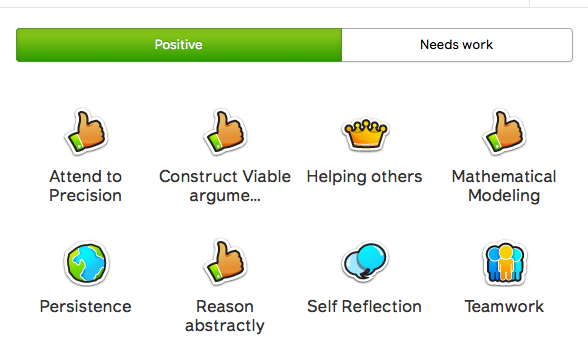 I have been doing some more work with running groups in a geometry classroom this year. We have introduced a set of skills that are closely related to the common core math practices. We identified skills such as constructing viable arguments from the common core and described what this might look like when students are working in groups. I have been encouraging students to argue…about math; modeling was described as drawing pictures, graphs or tables to model math problems. We are encouraging students to communicate precisely using mathematical language. They are being encouraged to look for patterns. All of these math practices are being tracked on Classdojo.
While Classdojo is a classroom management tool, because the common core math practices can be connected to specific behaviors, it can also be used to track the use of these standards in the classroom. If you want to connect the math practices to a specific skill like subtraction or the pythagorean theorem, this is totally possible. This is an extremely easy way to collect data.
In addition to tracking these behaviors on Classdojo, we are working to incorporate growth mindset and the ideas of complex instruction that I wrote about in several posts over the summer. This class is ripe with students who don’t have confidence around math. We are working diligently to develop tasks that allow students, especially those who don’t normally experience success in math, to experience success. We talk to them about these behaviors, which require no innate ability in math. As has been my theme this year, I am working to make kids feel smart. What are you doing to increase equity in your classroom and make kids feel smart? Is there a strategy you could share?
The post Common Core Math Practices and Classdojo appeared first on Fearless Teachers.
]]>