The post Learning the Hard Way & The Common Core Standards appeared first on Fearless Teachers.
]]> I have been actively implementing the English language arts common core standards for three years while at the same time learning and implementing research based strategies to increase growth mindset in our students. I recently completed a very close study of both the math and English standards while I was simultaneously teaching a course on growth mindset. There is an important connection to be made between these two ideas that may assist in clearing up some confusion about the value of the common core and in particular, some complaints about doing things the hard way.
A common complaint from parents about the common core is that they have a hard time understanding the way students are being asked to do common tasks like simple subtraction problems as reported in an NBC article by Michael Rubinkam, “2+2=What? Parents Rail Against Common Core Math”. 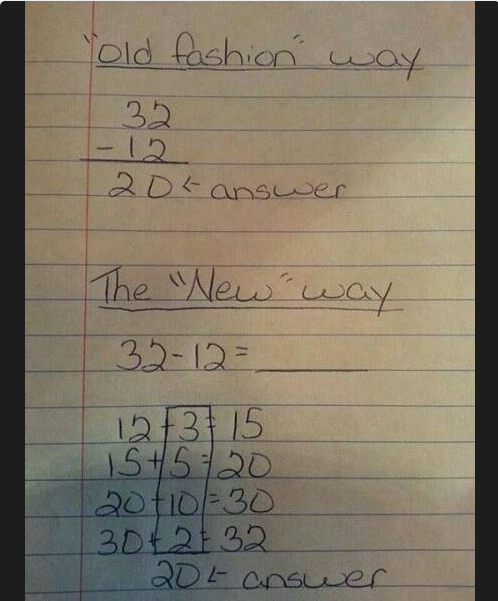 At first glance, this article appears to be making a valid point but only a superficial look at this strategy isn’t enough to understand the purpose of this process. This particular problem would be easier the traditional way. And for people with a fixed mindset, one that assumes that it is better for learning to come easily, the traditional way is a logical choice. There is a higher rate of quick success when we take the easy route. So, if speed is seen as a sign of intelligence and strength, the traditional method does make more sense.
Another look at this problem in relation to the nature of the standards and the idea of growth mindset may illuminate another perspective. Growth mindset focuses on the idea that success and achievement happen through hard work and deliberate practice. It assumes that struggle is a natural part of learning and this struggle creates deeper, longer lasting connections in the brain. In a growth mindset mistakes, struggle and effort are necessary in order to achieve high levels of success. When we look at the common core math practices, we see expectations for the ability to persevere, reason abstractly, construct viable arguments, model, use tools, be precise, look for structure, and identify patterns. These are high level thinking skills that require more than rote memorization of processes. Perseverance, for example, by its very definition requires making mistakes, learning from them and continuing to work on solving a problem using this learned information. So, in order to succeed at this particular math practice outlined in the common core, one would have to be comfortable making mistakes. Someone with a fixed mindset would struggle with this. In the math example provided in the photo, students are required to practice additive reasoning, a key skill in learning multiplication and division and also a key skill in developing skills in more abstract mathematical concepts. So, yes, this may be a harder way but the skills that the two methods address are different. The additive reasoning skills will help students succeed later on when math gets harder and more abstract.

So, why do we have to do things differently? Well, in today’s economy, students don’t just need to know how to do the easiest thing. In fact, they need to be able to innovate, think flexibly, and adapt to quickly changing and novel situations. They need to be highly creative since they are now competing with a global community rather than just others in their local communities. Times are different for children today than they were for us (although I wouldn’t suggest that the old way prepared our generation either). The old way may have been okay for our parents but it isn’t going to work for us or our children. Looking at one difficult math problem and concluding that the common core is a detriment to education is short sighted. I’m not saying it is a perfect document but I would be hard pressed to argue that the way that I was taught was the best way out there. Our kids need to learn to struggle through these difficult tasks in order to develop necessary skills for their 21st century success. We need to promote a growth mindset and struggle through it with them. If you don’t know how to do the homework, be a partner in helping them figure it out. Check out this Will Smith story about building a brick wall. It would have been easier to hire someone else to build that wall but Will Smith has been pretty successful not just financially but as someone who states his life is satisfying. We may have to start embracing challenge, as Will Smith did, rather than fighting it or trying to find an easier way. So, maybe it’s okay to do things the hard way?
The post Learning the Hard Way & The Common Core Standards appeared first on Fearless Teachers.
]]>The post Common Core Math Practices and Classdojo appeared first on Fearless Teachers.
]]>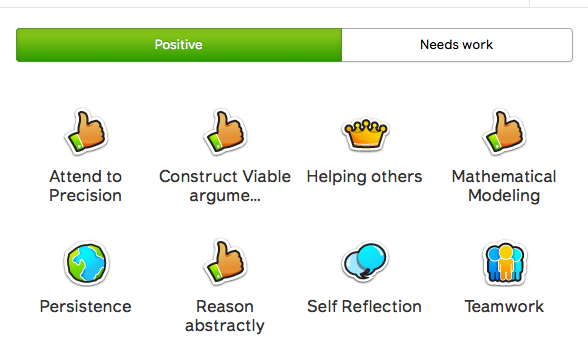 I have been doing some more work with running groups in a geometry classroom this year. We have introduced a set of skills that are closely related to the common core math practices. We identified skills such as constructing viable arguments from the common core and described what this might look like when students are working in groups. I have been encouraging students to argue…about math; modeling was described as drawing pictures, graphs or tables to model math problems. We are encouraging students to communicate precisely using mathematical language. They are being encouraged to look for patterns. All of these math practices are being tracked on Classdojo.
While Classdojo is a classroom management tool, because the common core math practices can be connected to specific behaviors, it can also be used to track the use of these standards in the classroom. If you want to connect the math practices to a specific skill like subtraction or the pythagorean theorem, this is totally possible. This is an extremely easy way to collect data.
In addition to tracking these behaviors on Classdojo, we are working to incorporate growth mindset and the ideas of complex instruction that I wrote about in several posts over the summer. This class is ripe with students who don’t have confidence around math. We are working diligently to develop tasks that allow students, especially those who don’t normally experience success in math, to experience success. We talk to them about these behaviors, which require no innate ability in math. As has been my theme this year, I am working to make kids feel smart. What are you doing to increase equity in your classroom and make kids feel smart? Is there a strategy you could share?
The post Common Core Math Practices and Classdojo appeared first on Fearless Teachers.
]]>The post ClassDojo and The Common Core appeared first on Fearless Teachers.
]]>ClassDojo and ELA Standards
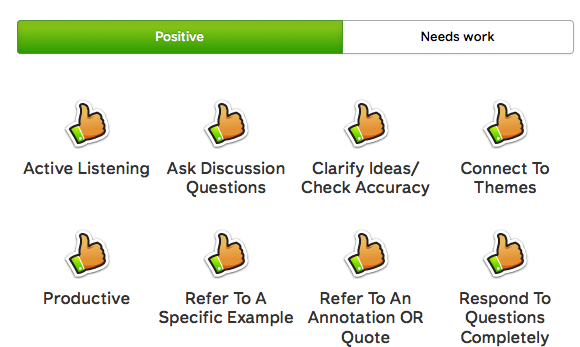 In the English Language Arts standards, the speaking and listening standards focus on group discussion behaviors such as coming “to discussions prepared” and “referring to evidence from texts”. These are specific behaviors that can be taught, practiced, observed and reinforced using ClassDojo. Our 11th grade students have become accustomed to ClassDojo as a way to assess their progress toward standards. We introduce the standard being assessed and break down what it looks and sounds like. We illustrate how those behaviors look in ClassDojo and how that information will impact their grades. Because students know specifically what behaviors are associated with the standard, it is much easier for them to experience success.
ClassDojo and Mathematics Standards
The Math standards focus not only on procedures but math practices. When these math practices are unpacked, behaviors such as “explaining reasoning” and “check answers”, become easily measurable. Our Algebra 2 teacher has identified behaviors associated with productive mathematical discussion, taught the behaviors, and used ClassDojo to reinforce the learned behaviors. She regularly uses groups in her classroom and consistently uses ClassDojo to assess whether the behaviors are being exhibited. Even though the intent of connecting the behaviors to the standards is to teach the standards, it clearly leads to more productive groupwork and solid classroom management.
Grading
While I would love to simply get rid of grading altogether, it is still a requirement for most of us. We are suing ClassDojo to grade individual participation within a group. While I have some mixed feelings about this, I feel better that it is connected to standards, it is based on many observations and it is a measure of an individual’s contribution to the group rather than a group grade. Many teachers and districts are experimenting with standards based grading and classDojo can be used to track standards when used as I have described above. We have not done this yet but I can see how it would work quite seamlessly. ClassDojo creates reports that illustrate how frequently certain behaviors are being exhibited. A percentage of time a behavior has been exhibited could be associated with mastery or proficiency, whatever your system requires. Similarly, a 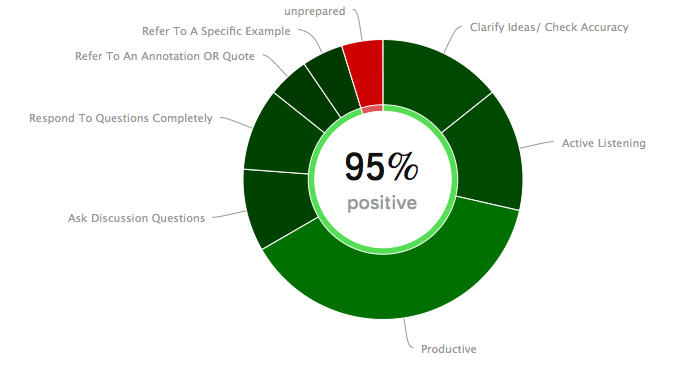 behavior could be considered consistently exhibited after a certain amount of times. It would be necessary to determine a criteria but it definitely has options. The reports can be generated for a whole class or an individual student and used as an instructional tool as well.
Isn’t It Behavioristic?
While many might argue that ClassDojo is behavioristic, when used in the way I have described, it is more of a teaching tool than a behavior modification tool. We are using it to reinforce behaviors but the ultimate goal is for students to gain intrinsic motivation through experiencing success. Eventually, those behaviors will be internalized and students will enjoy exhibiting them. And, if the behaviors are associated with specific standards then it is more closely related to learning than behavior. It is kind of like smiling even when maybe you don’t really feel like it. It doesn’t hurt you and sometimes it makes you feel better, so why not? Be specific and deliberate when choosing the behaviors you want to reinforce. Don’t choose violence as a behavior that you are going to track if that isn’t an issue in your classroom. Identify what it is you want students to learn and then translate that into specific behaviors. This way, the tracking of behaviors is directly connected to a long term learning goal and not a short-term behavior intervention.
The post ClassDojo and The Common Core appeared first on Fearless Teachers.
]]>