The post ClassDojo and The Common Core appeared first on Fearless Teachers.
]]>ClassDojo and ELA Standards
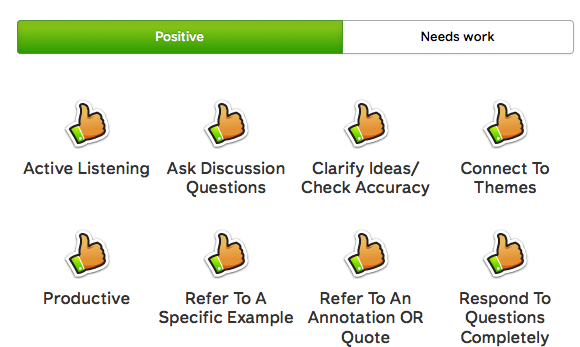 In the English Language Arts standards, the speaking and listening standards focus on group discussion behaviors such as coming “to discussions prepared” and “referring to evidence from texts”. These are specific behaviors that can be taught, practiced, observed and reinforced using ClassDojo. Our 11th grade students have become accustomed to ClassDojo as a way to assess their progress toward standards. We introduce the standard being assessed and break down what it looks and sounds like. We illustrate how those behaviors look in ClassDojo and how that information will impact their grades. Because students know specifically what behaviors are associated with the standard, it is much easier for them to experience success.
ClassDojo and Mathematics Standards
The Math standards focus not only on procedures but math practices. When these math practices are unpacked, behaviors such as “explaining reasoning” and “check answers”, become easily measurable. Our Algebra 2 teacher has identified behaviors associated with productive mathematical discussion, taught the behaviors, and used ClassDojo to reinforce the learned behaviors. She regularly uses groups in her classroom and consistently uses ClassDojo to assess whether the behaviors are being exhibited. Even though the intent of connecting the behaviors to the standards is to teach the standards, it clearly leads to more productive groupwork and solid classroom management.
Grading
While I would love to simply get rid of grading altogether, it is still a requirement for most of us. We are suing ClassDojo to grade individual participation within a group. While I have some mixed feelings about this, I feel better that it is connected to standards, it is based on many observations and it is a measure of an individual’s contribution to the group rather than a group grade. Many teachers and districts are experimenting with standards based grading and classDojo can be used to track standards when used as I have described above. We have not done this yet but I can see how it would work quite seamlessly. ClassDojo creates reports that illustrate how frequently certain behaviors are being exhibited. A percentage of time a behavior has been exhibited could be associated with mastery or proficiency, whatever your system requires. Similarly, a 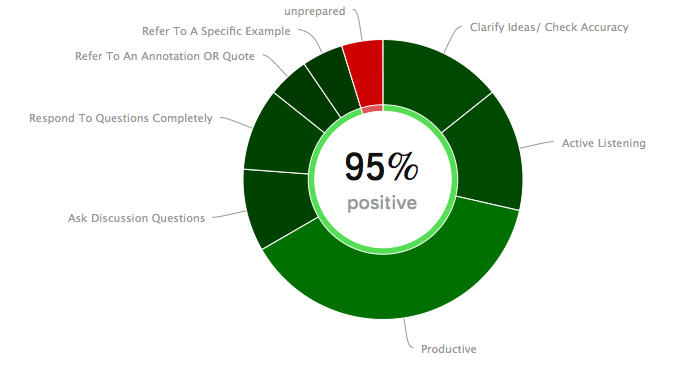 behavior could be considered consistently exhibited after a certain amount of times. It would be necessary to determine a criteria but it definitely has options. The reports can be generated for a whole class or an individual student and used as an instructional tool as well.
Isn’t It Behavioristic?
While many might argue that ClassDojo is behavioristic, when used in the way I have described, it is more of a teaching tool than a behavior modification tool. We are using it to reinforce behaviors but the ultimate goal is for students to gain intrinsic motivation through experiencing success. Eventually, those behaviors will be internalized and students will enjoy exhibiting them. And, if the behaviors are associated with specific standards then it is more closely related to learning than behavior. It is kind of like smiling even when maybe you don’t really feel like it. It doesn’t hurt you and sometimes it makes you feel better, so why not? Be specific and deliberate when choosing the behaviors you want to reinforce. Don’t choose violence as a behavior that you are going to track if that isn’t an issue in your classroom. Identify what it is you want students to learn and then translate that into specific behaviors. This way, the tracking of behaviors is directly connected to a long term learning goal and not a short-term behavior intervention.
The post ClassDojo and The Common Core appeared first on Fearless Teachers.
]]>The post Sample Lesson Plan for Cooperative Groups Part 2 appeared first on Fearless Teachers.
]]>In this sample lesson plan, a general activity is used to show how cooperative learning elements can be embedded to structure the lesson for improved productivity. Use any worksheet that requires answering questions or solving math problems. For the purposes of providing a specific example, imagine students have engaged in a mini lesson on graphing lines and this is a math worksheet that requires to practice finding and graphing lines.
Social skills
Choose a social skill to focus on. Communicate to students what is required for successful demonstration of the social skill. For this example, the social skill will be that everyone participates. This addresses a common problem that many people complain about regarding group work, but you should pick a social skill that you particular students need to develop. Here are some examples of other social skills that can be used at a variety of levels: eye contact, volume, taking turns, asking questions, reaching agreement, following through, managing materials, staying with your group, ignoring distractions etc. Any skill can be used but choose one or at most two to focus on until it becomes automatic and no longer needs to be reinforced. So for this lesson I have chosen everyone participates.
Positive Interdependence
The most important way to structure positive interdependence is to make sure there is a common academic goal. The goal for this lesson will be that each member of the group is able to graph a line using slope intercept form. This goal must be communicated at the beginning of the lesson. In order to strengthen positive interdependence for this lesson I will add an incentive of no homework if everyone in their group gets above an 80% on the quiz (because they met the academic goal, there is no need for practice on this skill). Also, I will be asking students to develop a team name that incorporates the strengths or interest of all team members. The final piece I will add are roles. There will be four roles: checker, materials person, task master, and investigator. The checker makes sure that everyone understands how the group arrived at a certain answer. The materials person deals with any materials needed or things like sharpening of pencils and getting more paper. The task master makes sure that group members stay on the same problem and stay on task. And the interrogator seeks help when needed from other groups or the teacher as a last resort. I have added a lot of structure here. In the beginning, I suggest more over less.
Individual Accountability
The individual accountability for this short lesson is a simple, a short quiz at the end of the lesson to demonstrate the learning of each group member. In addition, as students are working, I am circulating the room tracking who is participating in order to give a participation grade. I have used Classroom DOJO in both English and high school math classes to track behaviors. One last effort is to randomly collect one worksheet for a classwork grade. So we have three ways to hold each member accountable for learning the material.
Group Processing
At the end of the lesson each group will share one thing that their group did that helped make sure everyone met the learning goal. We will process this as a whole group.
Face to face interaction
Each group will be required to sit in a foursome, facing each other. Members should not leave the group unless they are the materials person or the investigator seeking help from another group.
There are some important things to remember about how to implement this type of lesson. First of all, make sure students know what you are looking for while you are circulating and be specific. For this social skill, you would want to illustrate specific behaviors. “If you are participating, I would see you asking questions, pointing to problems, sharing an answer, asking if everyone understands, writing down steps” etc. Make sure they know what the social and academic goals are before they begin. Also, they need to know that there will be a quiz and that there is an incentive if everyone participates. Do not talk over students when giving instructions. If you have difficulty maintaining attention during instructions, consider writing them down and making it the task master’s job to check the written instructions for the expectations. Or use the written copy as a back up if some students miss the instructions. Don’t get stuck helping groups for too long. This detracts from you ability to track their participation and it also prevents them from relying on each other.
I consider this to be a fairly basic lesson that incorporates some cooperative group structures that will promote productive groups. A true cooperative learning project would be set up so that each role would need to be completed in order for the group to be successful. Having said that, I think it is important to play around with these structures before you also add complex academic tasks. A certain level of confidence is important in running groups and it is okay to start small. I also highly recommend the resource Cooperative Learning Where Heart Meets Mind
The post Sample Lesson Plan for Cooperative Groups Part 2 appeared first on Fearless Teachers.
]]>