The post 4 Big Ideas About Proficiency-Based Assessment appeared first on Fearless Teachers.
]]>One common misconception about proficiency-based learning (competency-based learning) is that it is about changing a grading system. In particular, when people discuss proficiency-based assessment, they immediately start discussing the one through four scales for measuring learning. The 1-4 scale of measuring achievement came from the creation of learning scales meant to help students understand where they were in a learning process and, in my opinion, have been misused as the levels are assigned numbers and get averaged together to come to a traditional grade. These numbers are meant to represent learning on a specific skill and all meaning is lost once we begin translating these numbers into a traditional grade by averaging them with numbers that represent other skills.
Reflection is assessment
I recently taught a class on proficiency-based assessment using the text Proficiency-Based Assessment: Process, Not Product (Gobble, Onshuck, Reibel, Tadwell, 2016). By the end of the book, it is clear that reflection is a key component of the assessment process. After reading this text, I actually went so far as to interpret that reflection is assessment itself. I have been relying solely on reflection and collection of evidence as the assessment method for my entrepreneurship class.
Assessment is not a product
I love this quote from Proficiency-Based Assessment: Process, Not Product, “assessment is a process of gathering evidence, not a product that gathers evidence” (Gobble, Onshuck, Reibel, Tadwell, 2016). Although it rocks the world of formative and summative assessment, it illustrates the difference between traditional assessment practices and proficiency-based assessment practices. I’m still trying to figure out how formative and summative assessments fit into this shift if there is no need for a product because we are collecting evidence. I suppose summative assessments just become evidence but I’m still thinking on this idea.
Assessment is the learning process
When assessment starts to become about the process of gathering evidence and reflecting on it, all of a sudden, it is not separate from the learning. The reflection is where we actually see the thinking that represents learning. I feel like it’s even beyond the idea of assessment for learning, but it is certainly closely related. It does appear that the need for separating the idea of formative and summative assessments is being called into question.
In the end, I don’t think grades have any place in Proficiency-based learning or assessment. Proficiency-based learning is about expecting that all students are capable of learning at high levels when provided with personalized instruction that allows students to learn at their own pace. If competency education is about becoming competent, then a system that is based on an outside person evaluating individual attempts at assignments and summative assessments really has no place. I can’t even begin to reconcile grades in a competency-based system when I think about them being used to rank and sort. In a proficiency-based system, we need to start separating and thinking differently about the assessment and reporting process @fearlessteachers #nogrades.
The post 4 Big Ideas About Proficiency-Based Assessment appeared first on Fearless Teachers.
]]>The post Book Review: Grading appeared first on Fearless Teachers.
]]>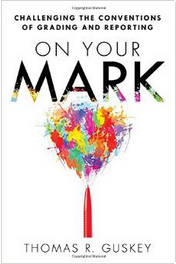 One of the most debated topic these days seems to be grades. Educators are really beginning to question the traditional grading system on a large scale. In the past, these discussions have always ended with “but that’ll never happen” and now people are making changes in their classrooms, their schools and even on a larger scale in some districts. Some of us have been ready to unload grades for a long time. We see the toll it takes on student learning. And others are just starting to explore what changes might look like and what they mean in terms of learning. It is really an exciting time. I was asked to read On Your Mark, by thomas R. Guskey as part of the leadership team in my building. Guskey makes a convincing argument for the adjustment of many of our grading practices. Of course, he is preaching to the choir with me. But, his arguments are articulate and well supported with evidence and examples. He challenges many common grading practices used by teachers and provides potential solutions to each challenge. If you are thinking about grading issues or considering making some changes in your grading systems, this is a useful book. If nothing else it will get you thinking. As a member of the leadership team which will be investigating how these issues might impact the bigger system, it helped me see the bigger picture. A quick read that will definitely get you questioning your current grading practices.
The post Book Review: Grading appeared first on Fearless Teachers.
]]>