The post Increasing Grit During Groupwork appeared first on Fearless Teachers.
]]> If you have experienced common groupwork issues like one person completing all the work, these high impact strategies can be implemented tomorrow for use with just about any lesson plan you have in mind in order to increase participation, grit and perseverance. If you weren’t planning on groupwork, most lessons can be transformed rather easily. This is a solution for those new to using groups or if you have tried running groups and they have not been productive.
“Quick start”
The “quick start” is surprisingly simple and effective for getting students to take initiative and get on task right away. Start class letting your students know that you are looking for a “quick start”. This can happen if you use an entry task or it can be a direction whenever you want kids to get right to work. If there is a specific behavior that should be happening, this can be requested as well. For example, “I’ll know you’re off to a quick start when I hear someone reading the first question”.
Everyone stays on the same question
Positive interdependence is a key element of cooperative groups that requires that students are dependent on one another for their success. Strategies that promote positive interdependence send the message that the group will “sink or swim together”. One way to encourage this is to require that all students are on the same problem. In order to make this strategy work, it is imperative that students get the message that the goal of the groupwork is not to “finish”. The focus of the task must be on making sure everyone demonstrates quality responses to each question, problem or task. This must be clearly stated from the start of the groupwork. Students may need reminding of this throughout the work time.
Randomly collect one assignment
Individual accountability is a second key aspect of cooperative groupwork. This next strategy encourages each student to learn the material because they know that they may be held accountable for it. The two ideas I am going to outline are particularly high impact because they not only promote individual accountability but also encourage students to work together so they promote positive interdependence as well. In the directions for the task, tell students that you will only be collecting and assessing (or grading) one product randomly from the group and that you will be looking for quality responses or accuracy (whichever makes sense) not completion.
A second option that is a little more complicated is a “Shuffle quiz” which I learned about this past summer and have seen be very effective at solidifying groups working together more equally. A shuffle quiz works on the same premise as collecting a random paper but is more interactive. This works well when you are looking for understanding of a specific concept. Consider an example where students are working to demonstrate comprehension of a reading assignment or understanding of a math procedure or a math concept using a worksheet type assignment with questions. In this case, when the group feels everyone in the group can demonstrate understanding, they get your attention (perhaps they sign up on a list located on the board or they turn a solo cup over to show you they are ready) and you arrive at their group to do an oral quiz. Behind your back, shuffle each student paper and choose one without looking. This is the student who gets the random oral quiz. If they do a satisfactory job, they can move on to the next set of questions or the next task. If they do not provide satisfactory responses, then they continue to work and call you over when they think they have got it.
Stay out of it!
 When you help, they don’t need to work together. If they know you are coming over when they start to fall apart, they will start to fall apart. In order to increase student grit, it is important for you to stay out of it! You must require them to work through it. If you do a shuffle quiz, you will not have time to intervene with struggling groups. If you have a tendency to intervene, you can occupy yourself by taking notes on student thinking and misconceptions which you can then use to discuss at the end of class or to develop your next lesson to address these observations. Another way to occupy yourself is to use a behavior tracking system. This can be as simple as a chart with the names of your students where you take notes, a chart with lists of behaviors and student names or an app like class dojo which I have seen work at every grade level. It can be uncomfortable to watch groups struggle or be unproductive when they get stuck. Once they experience getting unstuck, however, it can be extremely empowering and those experiences give them the skills to persevere and develop grit for future problems.
When a group is shutting down
If a group is really shutting down, remind them about any resources they have access to like the internet or notes. You can give one member permission to ask another group for help. Or you can offer a hint to one member of the group. Only allowing one member to get help forces that member to share the information with their own groups so it encourages them to get back to working together.
Don’t expect perfection the first time but you should see an immediate increase in productivity. They are simple enough to embed into almost any lesson plan and don’t require a lot of student introduction. The more kids work with these strategies, the more routine it will become. You can introduce them one at a time as well if you are skeptical. Please let me know how it goes by commenting, reaching out on Twitter @fearlessteachrs or emailing me directly.
The post Increasing Grit During Groupwork appeared first on Fearless Teachers.
]]>The post We Might Let You Fail Because We Believe In You appeared first on Fearless Teachers.
]]>When I was in Finland a teacher said to me, “we don’t worry if a child doesn’t learn to read on our timeline; w
 e trust that they will eventually; we believe that they will learn to read”. The fact that the words “trust and believe” are right next to each other in this sentence is very important because trusting that it will happen sends the message that the teacher believes in the child. Getting that message is very important because when somebody believes that they are capable, they are likely to persevere in order to achieve or succeed. It’s a self-fulfilling prophecy. This same teacher also shared that they provide services to students who may not be learning at the expected pace. All students access this assistance if they need it. There is no stigma associated with the interventions because there is no evaluation process overtly being used. This same method works for adults as well. When administrators trust that teachers will do the right thing; when they trust that they are qualified; that they do know what’s best for their students and are given the autonomy to do those things then teachers get the message that they can do it and they do.
The intent is not to give people free reign to do whatever and then never check-in. But is it best practice to assume the worst? Maybe a better way is to assume the best, provide clear expectations and accountability measures and trust people until they are not trustworthy. Trust is not about getting people to do what we want them to do. That is a really difficult and important distinction to make. For example, if a teacher assigns an open ended project to a student and they do not complete the project as planned, one response might be to conclude that this student can’t be trusted to complete projects independently. If we assume that this is not an indication of untrustworthiness, we might have a different response. It could be a time to conference with the student and identify what worked and what didn’t. This demonstrates that you trust and respect their ability to grow and change.
So, if a student doesn’t learn certain material or complete a task as planned, it doesn’t necessarily mean that you were wrong to trust them. This is very hard to come to terms with but in order to send the message that you believe in the student, this is a necessary step. It’s important to understand that part of trusting is allowing people to fail and being okay with that. Responding to this failure is where all the action happens. Setting new goals based on the failure allows us to meet people where they are at and this is a very effective way to make progress. The quickest way to learn is to fail, so processing those mistakes, processing those failures leads to quicker change. Most people are trying to avoid failure (a natural instinct), but in reality failing is a very efficient way to learn. If setting new goals doesn’t work over and over again, well, then trust becomes an issue. Or maybe there is another issue to address.
The post We Might Let You Fail Because We Believe In You appeared first on Fearless Teachers.
]]>The post How Are You “Smart” At Math? appeared first on Fearless Teachers.
]]>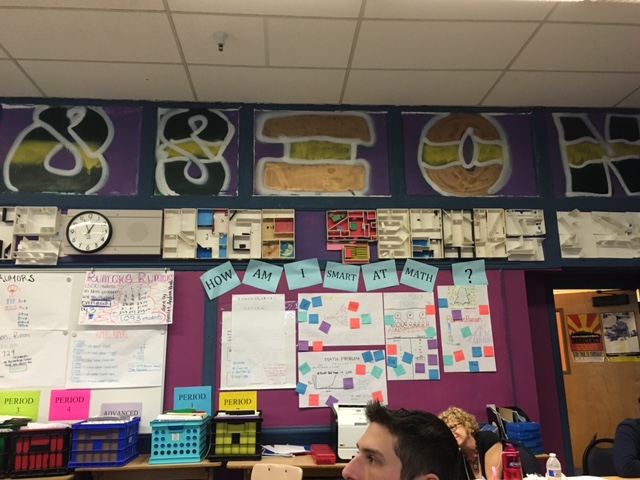 What does it mean to be “smart” at math?
Traditionally, one who is fast at math is good at math or smart at math. If it comes easily that is considered a good thing. I recently visited several schools that are communicating a different message about math. I also attended the Creating Balance in an Unjust World Conference at one of the high schools. Burton and Mission high schools in San Francisco graciously welcomed us into their classrooms to observe and reflect on the learning that was going on. Their district math departments are using an idea called Complex Instruction . As has been the case with all my visits so far, I saw nothing wild and crazy; nothing that couldn’t be implemented with any student in a rural Vermont school with an economically diverse population. The most important thing I noticed was that students weren’t talking about right answers. It was unclear to me who was “fast” at math and who was struggling. Since I am trained in special education, it is my general tendency to search for the struggling student but just as I thought I might have found one, that student would make an astute observation or ask an insightful question and I would question myself. It became clear that these teachers communicated that it doesn’t matter who is fast and I will certainly be working on my bad habit of looking for the weak links.
Creativity
So if math isn’t about right answers and speed, what is it about? Looking in from the outside into these classrooms, it seemed to be about a creative process. Teachers shared that they spend their planning time developing tasks that force students to look at common math skills from a different perspective which in turn forces students to think about the concept rather than focus on memorizing procedures. Once such task required students to draw a picture of various fractions. This went fairly smoothly until 3/2. At that point, students started to talk about the fractions as ideas rather than think about the numbers. This was a pre-calculus course and the teachers had identified that ratios were a weakness conceptually so these tasks were created to strengthen upcoming work with trigonometric identities.
Relationships
 Math was also about collaboration, communication and relationships. The interconnectedness between people, ideas, events, phenomenon, and in general, anything relevant to the students’ lives was the focus of planning math lessons and thinking about math skills. At the conference, the first example of “social justice math” was in regards to payday loans presented by Joel Walsh from UCS Hybrid school. In order to learn about logarithms and exponential equations through an investigation of payday loan providers. They explored how these business practices exploit low-income and minority populations in their own communities. We actually called a local payday loan business and questioned them to gather information right there during the conference. Ken Collins from Charlotte Latin School explored the question of how we can use math to in voting to help reflect the “will of the people”? Finally, the last example came from a Vanson Nguyen, a community college teacher who used various forms of data to encourage students to solve real world social problems or consider social questions. In one example, students collected a variety of data related to their school population. They chose the most compelling data, which is itself a math skill, and then they collected and compiled more data to propose a solution. In the second example, his students considered a popular music group. They looked for social themes presented by the teacher and compiled the data about how many times these themes came up in an album. Using this information, they formulated an argument about whether or not these bands were positively or negatively impacting the social issue. In both these examples, the mathematical concepts for the course were explored through the problems presented. When this instructor fielded questions about rigor he and I had similar thoughts. The focus is on engagement because when students are engaged they can learn the math. People who argue that it isn’t rigorous aren’t thinking mathematically about it. If a disengaged student requires 3 months to learn how to solve equations because of their disengagement and lack of purpose, this is highly inefficient. A student who spends a month exploring a fascinating idea and only a couple of weeks learning how to solve equations in that context has learned the skill in half the time and doesn’t hate math either.
Math is everywhere
When I left these classrooms as well as began to process the examples shared at the conference, I began to see math everywhere. All sorts of data started popping up in my head that I had never considered before. Questions about how Uber software worked; the math behind the best stance to get a bulls eye in darts. The math related to these questions began to scream in neon signage all over my brain. I started looking for math everywhere. We should be looking for math everywhere as we develop math curriculum in order to engage students, make math more personal for students and at the very least make sure students don’t hate math. I understand the importance of fluency in completing math procedures but what if math isn’t about procedures?
Many thanks to Taica Hsu and Hossein Koch from Mission High School and Mr. Pablo, Mr. Yamamoto, and Mr. Popalisky for allowing us to observe their classrooms.
The post How Are You “Smart” At Math? appeared first on Fearless Teachers.
]]>The post Creating a Culture of Failure appeared first on Fearless Teachers.
]]>Vermont’s move to ward more personal and proficiency based learning in public education is an enormous shift from the traditional model that we have been using for many years. While Vermont is extremely innovative inside the classroom and offers its teachers quite a bit of autonomy compared to many other states, the overall structures and systems in public schools rely on a traditional model. For many years, I have watched administrator after administrator try to implement an innovative vision with very limited success. Because I see Vermont’s new legislation, Act 77 and Education Quality Standards, as an amazing opportunity for transforming public education, I truly do not want to see it fail. I have been thinking, reading and synthesizing all I can in order to ensure that we build models for this change that can be successfully used by any school.
In order for learning to be more personal, students need to be trusted partners and collaborators in the development and design of their learning trajectory. Students must be self-directed and teachers must change their roles to facilitating these new directions. These are huge shifts for teachers, students and their parents. Someone with a fixed mindset, the belief that the ability to learn, intelligence, is innate and unchangeable, whether it is a teacher, student or parent will struggle with these shifts. A teacher may have difficulty trusting that a student who was unmotivated in a traditional learning environment could be self-directed in a more personalized situation. A student who has previously been told what to learn and when to learn it will struggle to refocus their energies on finding their passions and making their own decisions about learning.
Imagine if those same teachers and students believed that they were capable of learning anything with the right amount of effort. Imagine those same teachers and students coming into school every day planning to make mistakes, take risks and persist in order to reach their goals. Imagine a school where students and teachers were praised for taking risks even when failure ensued. Imagine if students approached failure and mistakes as a sign of learning rather than a sign of failure. Traditional systems and structures are built on notions of a fixed mindset. Grades have been a focus rather than learning. Right answers have been praised over mistakes.
These are long held and deeply ingrained ideas that will take a lot of work to undo. Developing a growth mindset takes time. It isn’t enough to believe in growth mindset because many of our actions still carry a fixed mindset. Many conversations need to be had about shifting the focus of school from grades to learning; these conversations need to happen with all stakeholders. Most parents, teachers administrators and community members were products of traditional schools, so change will be hard. Administrators need to find ways to truly encourage risk taking in ways that teachers do not fear evaluative consequences. Teachers need to create the same culture for their students. What are the ways that you create (or don’t create) a culture where failure is a sign of intelligence?
The post Creating a Culture of Failure appeared first on Fearless Teachers.
]]>The post 8 Summer Activities That Can Improve “Grit” appeared first on Fearless Teachers.
]]>to understand more about “grit”. She references another important idea called “growth mindset” coined by Carol Dweck. It is the idea that intelligence is not fixed and can change based on experiences. To understand more about growth mindset, watch this video by Carol DweckThese ideas are now gaining momentum in the classroom. As summer approaches, students are leaving classrooms that may be building these skills. Expensive summer camps and programs do help kids get experiences that build these skills, but there are lots of simple ways to build these skills that can happen on the weekends for very little money. They also give families time to do things together whereas camps and other paid programs are not usually family inclusive. What can parents do over the summer to to build and maintain these skills?
1. Try New Things
Trying new activities and going to new places gives kids an opportunity to develop strategies that can help them deal with new situations in general. Novelty can be intimidating; the unfamiliar can be scary. The more new experiences kids engage in, the more strategies they acquire for dealing with novel situations in the future. Look around your neighborhood or stretch a short distance. Is there a museum you have never been to? A hike you have never attempted? A new park or beach? These local activities may not be a trip to Disney World, but they are free or low cost ways for family to connect and for kids to build skills associated with “grit”.
2. Set Goals
Setting goals and working to attain them is a necessary part of increasing “grit”. One of the characteristics of “grit” is the ability to follow through and maintain an interest in order to really “go deep”. Setting goals, breaking a task down into parts to make it attainable, these are necessary skills. Try creating a family goal. Maybe you all enjoy hiking and agree to hike 5 new mountains this summer, try 10 new foods, learn to do three new things, exercise every day. Whatever the goal, it really doesn’t matter. What matters is the follow through. You could do a family goal or individual goals. If you can’t get the kids involved, you can model this for them. Create you own goal and keep track of its completion on the fridge. Openly share how you are dealing with setbacks and failures. How to keep going after a failure?
3. Play games
Playing games gives kids the opportunity to lose and develop strategies for improvement. Many kids will lose and still enjoy themselves. You can talk to them about what strategies they used and what other ones they could try. You can model being a loser who works toward improving your game. If you have enough family members, team up with your children so you can problem solve together. These are opportunities for you to model perseverance when you are not succeeding. Many times, it takes multiple tries at something before experiencing success. Children who can work at something even when they have not succeeded are more likely to eventually reach success. If you have very young children, they may have very short attention spans, but encouraging them to go just a little bit further than they might have can help them build the capacity to persevere.
4. Volunteer
Volunteering is a wonderful and free way to engage in your community and with your interests. It helps kids develop connections with community members in areas that interest them. It allows them to extend their interests into the larger world. The act of doing something for the sole purpose of providing service with no expectation of getting anything in return provides an opportunity for kids to experience the reward of simply feel good about providing value. Receiving money for completing a job can feel good and there is nothing wrong with that, but there is an emotional gain from doing something for the purpose of just helping someone else. This reward can have a long-term effect on values. Once kids feel the benefits of providing service, they will be likely to continue this. Providing service can improve social skills and the ability to understand diverse groups of people. These are all important and marketable skills that will increase achievement academically and in your child’s future career.
5. Garden
Gardening is another activity that requires delayed gratification. Growing something requires some effort and also has a waiting period. Eating something that you have nurtured and grown is so satisfying. If you lack space, gardening in large pots is a good option. Tomatoes, lettuce and herbs are easily grown in pots. Gardening can lead to cooking, composting and a whole host of other activities. But related to developing “grit”, gardening allows kids to experience waiting for something; self control is an important skill for school and for learning.
6. Learn something new
Whenever we learn something new, we go through a process that requires us to work through frustration. Learning new things is difficult but also fun. Finding something that you can learn together as a parent/ child team or as a family gives kids an opportunity to work through some of these frustrations with modeling and support from you. There are some really fun and free things you can do together. I was recently intrigued by a website about magic tricks, Magic Tricks for kids, which does a great job of engaging parents and kids in learning how to do magic tricks. In addition to the abundance of resources available on the internet, check out your local newspaper for outdoor activities like orienteering; new or unusual activities that might be kid friendly are wonderful opportunities to learn together. Last summer I witnessed a mother daughter team taking a hip hop dance class together. It was new for both of them and they had a great time. Encourage kids to pursue personal interests out in their community; cooking, various sports, crafts, religion, pets, photography, art and any number of other hobbies or interests could be a catalyst for learning something new with our child.
7. Allow boredom
Don’t try to save your kids from being bored. Being bored is a part of existence. Let them work through it. When you notice that they have worked through it, help them reflect on what they did. Help them articulate the behaviors they exhibited that helped them so they can recreate those behaviors the next time they are bored. Be specific when stating the behaviors that our child exhibited to solve the problem. Check out more on the benefits of boredom in this BBC article.
8. Pay for Work
Here is an easy idea to help kids build strength around delayed gratification. Being able to wait for the benefits of hard work and steady effort increases a child’s ability to keep at something long enough to reap the benefits. During the summer, there are all kinds of extra jobs that need to get done around the house. A whole host of outdoor chores in addition to the usual house chores that now kids can contribute to since they have the time. Build a list of chores that need to get done around the house and attach a monetary value to each chore. Have kids track their hours and pay them weekly or monthly. Encourage them to save up for something and then buy it with their hard earned money.
Kids learn a lot in the “real school” of life. Creating these opportunities is easy and more fun than the routine of most traditional schools. Bring it back around and reflect on the learning that happened and kids will internalize these skills, bring them into the school setting and experience success in many areas of life. For fun, track your family activities on a blog or through photos as a way for you and your kids to reflect on how these activities are having an impact. For more on aspects of “grit”, check out this Edutopia Video and article about Grit. If you want to go further into this topic, try taking a free summer course yourself. Teaching Achievement addresses the idea of “grit” as well as other related topics. Above all, have fun!
The post 8 Summer Activities That Can Improve “Grit” appeared first on Fearless Teachers.
]]>